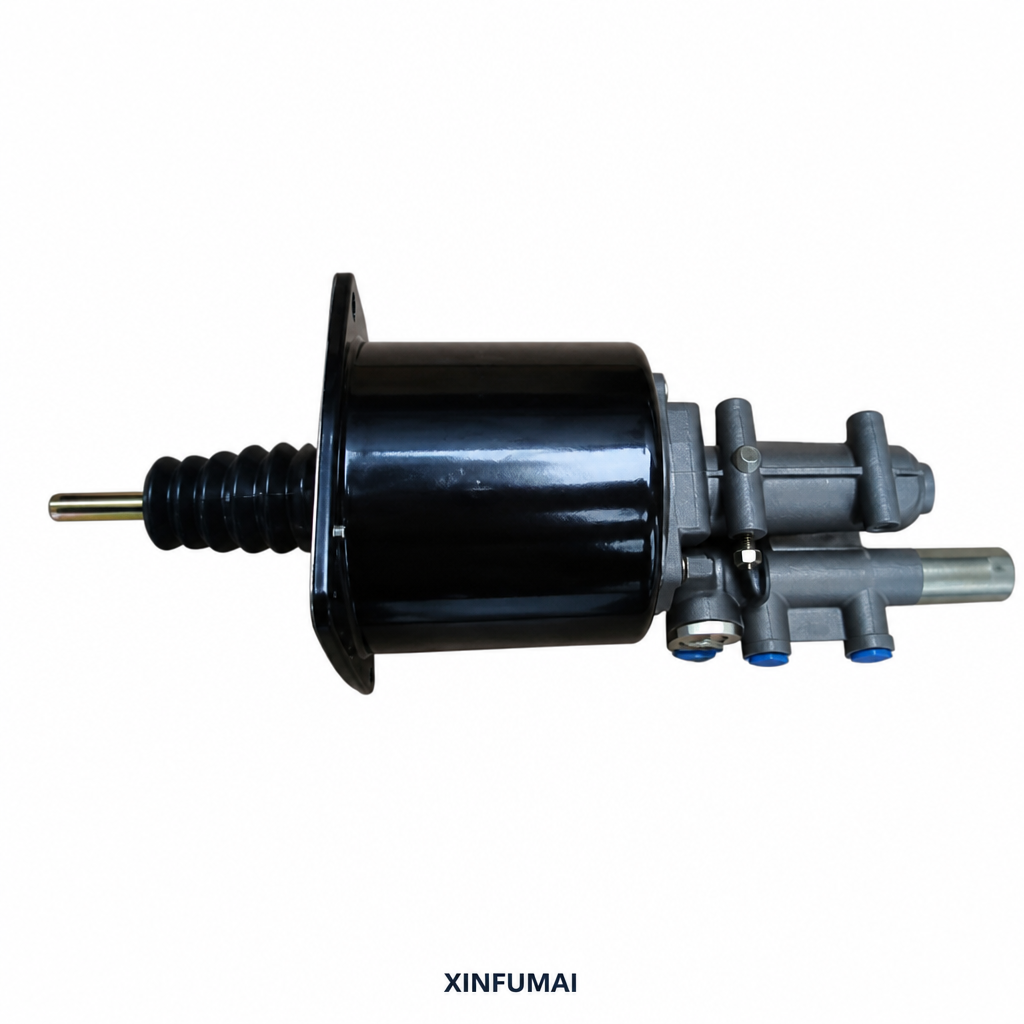
Reliable clutch booster supply is critical for heavy truck distributors, fleet maintenance buyers, and parts importers serving Sinotruk HOWO fleets. If you have searched “where to buy WG9725230041 clutch booster” or “who manufactures HOWO clutch booster,” you already know the challenge: much of the market is traders quoting prices without stock, with quality that shifts batch to batch.
The WG9725230041 is the OEM clutch booster assembly (also called the clutch servo or air hydraulic clutch booster) used in the clutch actuation system of Sinotruk HOWO heavy trucks. It is a pneumatic-hydraulic assist component: when the driver presses the clutch pedal, the booster draws compressed air from the vehicle’s air system and multiplies the pedal force many times over, so a high-torque clutch disengages smoothly with minimal driver effort. The unit is a precision assembly — machined housing, pilot control valve, diaphragm, and hydraulic piston — and it is a genuine wear-and-replacement part in every HOWO fleet’s maintenance cycle.
This guide is written by a Chinese clutch booster OEM supplier. We supply the WG9725230041 factory direct, in OEM replacement quality, to distributors and repair channels across Africa, the Middle East, Southeast Asia, Central Asia, and South America. Below you will find the full technical background, compatibility details, quality control process, and the practical steps to request a quotation.
For a distributor, the clutch booster is a high-turnover line item: it fails on a predictable cycle, it is cheap to ship, and demand is constant wherever HOWO fleets operate. But it is also a part where a single bad batch can burn a customer relationship — a failed booster strands a truck on the road, and the workshop remembers whose brand was on the box. That is why the question “who manufactures HOWO clutch booster” matters more than “who sells it.” A factory that tests every unit, controls its own machining, and stands behind the part number can give you the one thing a trader cannot: traceable, repeatable quality at a price that supports your margin.
The WG9725230041 clutch booster is the component that converts a light pedal press into powerful clutch release force on HOWO heavy trucks. It combines a hydraulic pilot stage with a pneumatic power stage, which is why it is classified as an air hydraulic clutch booster rather than a plain hydraulic cylinder.
| Product Name | Clutch Booster Cylinder (Clutch Servo) |
| OEM Number | WG9725230041 |
| Application | HOWO Heavy Truck |
| System | Pneumatic Hydraulic Assistance |
| Material | Aluminum / High Strength Components |
| Quality | OEM Replacement Quality |
| Supply | Factory Direct |
What the Booster Does in the Clutch System
The WG9725230041 is specified for the Sinotruk HOWO platform — the heavy truck series that dominates fleets across Africa, the Middle East, Central Asia, and Southeast Asia. Common applications include:
Need the full cross-reference list? Browse our Sinotruk HOWO spare parts landing page for fitment details and OE references.
HOWO trucks run high-torque diesel engines coupled to heavy-duty manual gearboxes (FAST/Sinotruk transmission families). The clutch must transmit engine torque reliably while remaining controllable. A large-diameter diaphragm clutch needs significant force to release — more than a driver can comfortably apply through a purely mechanical or hydraulic linkage over a full shift cycle. The pneumatic-hydraulic booster closes that gap: the vehicle’s own compressed air supply does the heavy lifting, while the driver retains full hydraulic control and feel.
Because the booster works with the vehicle’s air system, trucks operating in dusty or high-altitude environments — common across African and South American routes — place extra stress on seals, diaphragms, and valves. This makes the WG9725230041 one of the most frequently replaced components in the HOWO clutch line, and it is why distributors hold steady stock of this part number.
Before ordering, confirm the fitment against your truck’s specific configuration: cab generation, engine power rating, and transmission family. The HOWO platform spans multiple generations, and while the WG9725230041 covers the standard clutch actuation layout across HOWO, HOWO A7, and HOWO 371 applications, your supplier should ask for the vehicle model and VIN to verify the correct version. A serious manufacturer will do exactly that — because a wrong-fit part does not just fail, it damages the release mechanism it is bolted to.
Understanding the working principle is straightforward, and it matters for buyers who need to explain the part to their own customers:
When the driver releases the pedal, hydraulic pressure drops, the control valve closes, and the air in the power chamber exhausts. Return springs push the assembly back, and the clutch re-engages progressively.
For technicians and procurement teams, the practical takeaway is this: the booster is an amplifier, not a simple cylinder. Its performance depends on three variables — correct hydraulic fluid, clean compressed air, and the internal seals and diaphragm being intact. A booster that passes an air leakage test and delivers consistent stroke is a booster that will perform in service; that is exactly what our factory verifies on every unit before shipment. Learn more about how the air hydraulic clutch booster range is built.
Two details are worth understanding when you specify or sell this part. First, the control valve is the component that meters compressed air in relation to hydraulic pilot pressure — it is what makes the pedal feel progressive rather than on-off. Booster performance complaints are frequently traced to valve wear, which is why we machine and test this sub-assembly as a dedicated station rather than treating it as an off-the-shelf purchased part. Second, the exhaust cycle matters: when the pedal is released, the air in the power chamber must vent quickly and cleanly, or the clutch will re-engage late and accelerate disc wear. A properly rebuilt or new booster demonstrates crisp exhaust behavior on the bench; a tired one does not.
The symptoms below are the most common complaints from HOWO fleets — and they are also the search terms your customers use when they decide to replace the booster rather than repair it:
A quick field diagnosis distinguishes a booster failure from a clutch or hydraulic-line fault: with the engine running and air pressure at normal level, press the pedal and listen for air hiss near the booster; check the fluid level in the clutch master cylinder; and inspect the booster body for oil weep. If the hiss is present or the booster is leaking fluid, the booster itself is the suspect. If the pedal is hard but there is no hiss and the fluid level is correct, check the release fork and clutch adjustment before condemning the booster.
When these problems appear, replacing the clutch booster cylinder can restore clutch performance — and it is almost always more cost-effective than repeated roadside repairs. If your customer reports any of these symptoms, the correct answer is a tested OEM replacement unit, not a rebuilt booster of unknown history. For your own inventory planning, treat the booster as a scheduled-wear part: fleets that run hard duty cycles replace boosters on a predictable interval, and distributors who stock the WG9725230041 against that cycle convert maintenance demand into repeat orders.
For importers and distributors, the supplier decision is a supply-chain decision. This is where factory direct supply changes the economics of your clutch parts business.
Our plant is a professional clutch booster production facility, not a trading office. The WG9725230041 is produced on a dedicated production line covering aluminum housing machining, surface treatment, valve assembly, and diaphragm installation. We control the manufacturing process from raw material to finished, tested unit — which is the only way to hold consistent OEM replacement quality across thousands of pieces.
Working with the manufacturer also changes your paperwork. You receive batch test records, material certificates on request, and consistent packing that survives container transit and tropical humidity alike — documentation that matters when your customers ask where the part came from, or when you import into markets with stricter customs requirements. And because we control the production schedule, we can hold agreed stock levels for distributor partners instead of telling you “we will check with our supplier,” which is the answer you will never hear from us.
Quality is the reason buyers move from trading-company parts to factory direct supply. Every WG9725230041 clutch booster follows the same controlled process. See our clutch booster quality control page for the full testing philosophy.
The rule is simple and it is the core of our quality promise: every clutch booster is tested before shipment. No unit leaves the factory without passing the air leakage test and the performance bench test. For distributors, that means fewer returns, fewer warranty claims, and a reputation for supplying parts that work the first time.
| Factory Direct | Trading Company |
|---|---|
| Better price — factory cost structure | Higher cost — trading margins added |
| Technical support from engineers | Limited support, often none |
| Customization (OEM/ODM, private label) | Limited to stock items |
| Stable supply — we control production | Depends on suppliers; stock and quality vary |
| Full quality traceability per batch | Limited or no traceability |
| Direct communication, fast response | Message relay through middlemen |
For a part as safety- and performance-critical as the clutch booster, the gap is not theoretical. A trading company can source a unit from any factory on any given week; a manufacturer is accountable for every unit it ships. When a container of 500 boosters arrives at your warehouse, the question is whether every single one will work. That is a factory question.
The WG9725230041 is a global part because the HOWO platform is a global truck. Our export program is built around the markets where HOWO fleets are densest:
We support every entry model a serious buyer needs:
On the logistics side, every order is packed for long-haul sea freight: oil-sealed fittings, individual protective wrapping, and cartons designed for container stacking and rough port handling. We prepare the export documentation your forwarder needs — commercial invoice, packing list, and certificate of origin on request — and we quote with shipping options for your port so your landed cost is clear before you commit. Whether you are importing one carton to test the market or a full container ahead of peak season, the process is the same: confirm fitment, confirm price and lead time, ship, and support.
The WG9725230041 fits Sinotruk HOWO heavy trucks, including standard HOWO, HOWO A7, HOWO 371, and related HOWO heavy-duty tractor, dump, mixer, and cargo models using the HOWO clutch platform. Confirm your truck model and VIN with our team before ordering.
Yes. The WG9725230041 is manufactured to OEM replacement specification — matching the original Sinotruk part number application, dimensional tolerances, and performance requirements.
Yes. We supply wholesale, container, and annual contract volumes. Pricing is structured by quantity, and we can reserve production capacity for scheduled orders.
Yes. We offer OEM and ODM service, including private label, custom packaging, and engineering modifications where order volume justifies tooling investment.
Standard production lead time is 15–25 days depending on order volume; trial orders and in-stock items can ship faster. Lead time is confirmed in writing at quotation.
Every unit passes an air leakage test and a performance bench test before shipment, following our six-step quality control process from raw material inspection to final inspection.
Yes. Sample orders are available for quality verification before bulk purchase, with sample cost credited against your first volume order.
We support standard international terms including T/T, L/C for container orders, and agreed terms for long-term distributor accounts. Full terms are provided in our quotation.
Yes. We work with distributors through exclusive or semi-exclusive agreements, protected pricing, priority stock allocation, and technical and marketing support.
Send us your quantity, target market, and shipping port via the inquiry form or WhatsApp. Our export team will respond within 24 hours with pricing, lead time, and shipping options.
If you are looking for a reliable WG9725230041 clutch booster manufacturer in China, contact our engineering team for OEM quotation and wholesale cooperation. We answer fitment questions, provide test and packaging documentation, and structure pricing around your order volume.
WhatsApp
Inquiry
Factory Introduction
We are not a parts trader. We are a heavy truck clutch booster OEM manufacturer and global supplier — and we would rather earn your first trial order than sell you a single container you will regret.
Installing a clutch booster is simple — if you follow the rules. At our production base in Chongqing, every booster is bench-tested before it ships, and the most common warranty claims we see come from avoidable installation errors: dirty lines, trapped air, or a misaligned push rod.
Here are the 8 installation rules from our production base — the same rules we hand to every distributor. Pass them on to your workshop customers and you will cut fitment complaints to near zero.
After removing the old unit, run the engine for a few minutes to purge the lines — debris, oil and water must be blown out before fitting the new booster. Dirty lines are the number one cause of poor clutch performance and shortened service life.
Recommended working fluid: DOT3 or DOT4 synthetic brake fluid.
The maximum stroke of the shift control valve is 32 mm. When installing, push the push rod inward at least 32 mm. At the 32 mm point the spring force is under 120 N; as you push further, the clamping force on the valve piston rises to about 400 N (max 600 N). For best performance we recommend pushing the rod in to about 40 mm.
Make sure all air is expelled from the oil pressure chamber during installation, or boost assist will be weak and inconsistent.
Drain the old brake fluid from the existing lines and refill with the fluid specified by the original vehicle manufacturer.
The ball head of the push rod must seat correctly in the socket of the release fork. A misaligned ball head causes abnormal wear and premature failure.
Install the booster with the bleed screw facing upward — this is critical for complete bleeding.
The angle between the push rod and the centre axis must be controlled within ±5°. Follow the vehicle’s service manual for routine maintenance.
⚠ Warning: never adjust or operate the booster while it is not mounted on its fixing bracket.
Warning: Do not adjust or operate the booster until it is mounted on a fixed bracket.
Send us your OE part number (WG / DZ / 1608010 series) — we confirm the cross-reference within 24 hours, free of charge. You can also look it up online or download the full 44-number cross-reference catalog.
Clutch Booster WG9725230041 for HOWO – Factory Direct OEM Quality